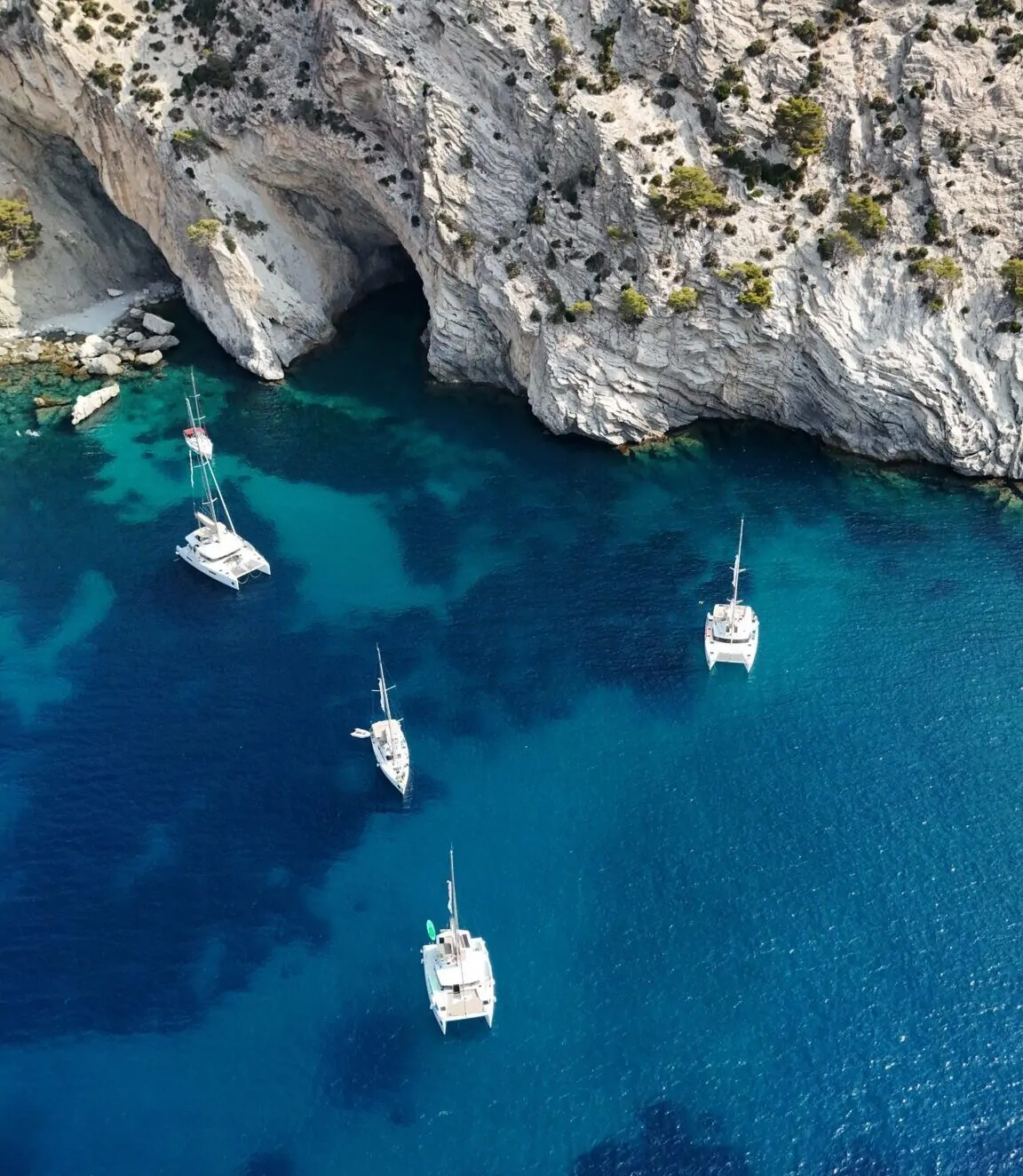
What Is a Gulet? Turkey’s Wooden Cruising Boat Explained

A gulet is a traditional wooden boat from Turkey’s southwest coast, usually with two masts, a wide beam and a broad flat deck at the stern. It started life as a fishing and cargo vessel. Today gulets are built and fitted out for holidays: cabins with private bathrooms below, cushions and a long shaded dining table above.
The important part for anyone comparing boats: almost every modern gulet is a motor-sailer. The engine does most of the work. Sails go up when the wind and the direction happen to agree, which on a week along the Turkish coast might be an hour on a good afternoon.
A gulet always comes with a crew — captain, deckhand and usually a cook. You are a guest, not part of the working crew. The classic version of this holiday is known locally as the Blue Cruise: short hops between bays, swim stops, lunch at anchor, dinner in a quiet anchorage or a small harbour.
A gulet (Turkish gulet, pronounced roughly “goo-let”) is a heavy wooden sailing-and-motor vessel from the Bodrum–Marmaris stretch of coast, where boatyards have been building them for generations. The name came into Turkish from the Mediterranean family of small two-masted trading boats.
What makes a gulet feel different from any other charter boat is the proportions. It is wide and heavy for its length, so it sits in the water rather than skipping over it. The aft deck is the living room: that is where you eat, sleep off lunch, read and watch the coast go by.
Below deck, cabins are compact but hotel-like, with ensuite bathrooms and air conditioning that normally runs only while the generator runs. Power, hot water and cold air on a gulet are a generator question, not a given.
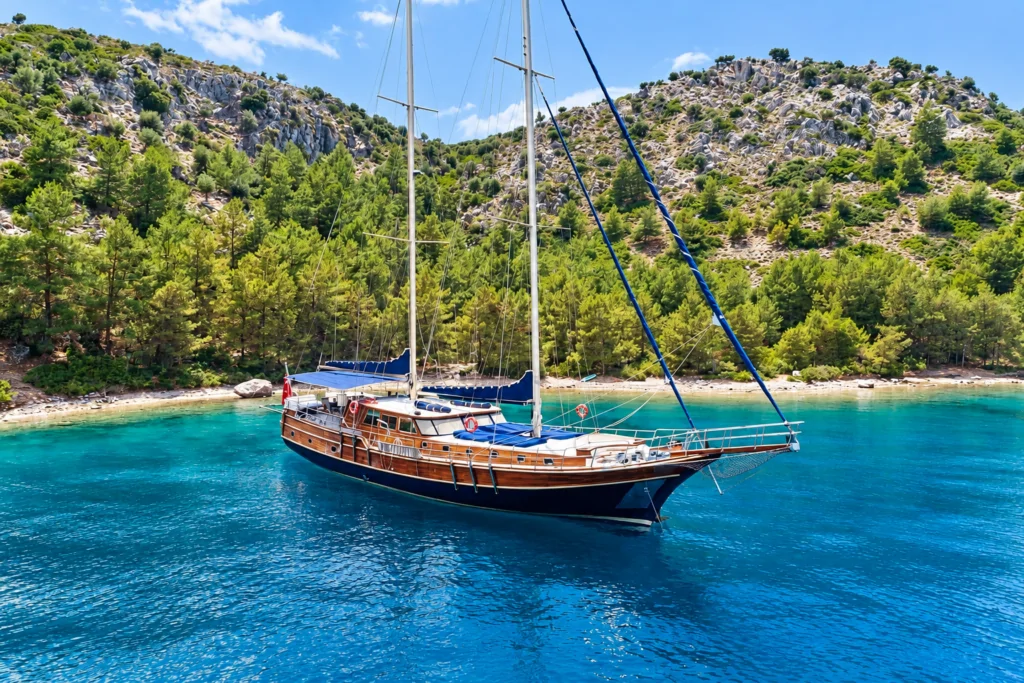
A gulet gives you the most space and shade and the least actual sailing; a monohull sailing yacht gives you the most sailing feel and the tightest cabins; a catamaran sits between the two. Which one is right depends less on looks than on how much you want to touch the boat.
| Gulet | Sailing yacht (monohull) | Catamaran | |
|---|---|---|---|
| How much you sail | Mostly engine, sails occasionally | Sails whenever there is wind | Sails well, motors easily |
| Motion at sea | Heavy and steady, little heel | Heels under sail, more movement | Stays flat, gentle pitching |
| Deck space | Largest, with shade and a big table | Smallest | Wide saloon, cockpit and trampoline |
| Cabins | Hotel-style, ensuite | Narrow, close together | In the hulls, real privacy |
| Who steers | The crew, always | You can, with a skipper teaching | You can, with a skipper teaching |
| Crew | Always included | Optional: bareboat or skippered | Optional: bareboat or skippered |
| Best for | Calm coastal cruising in sheltered bays | Learning to sail, sailing as the point | Comfort plus real sailing, shallow anchorages |
Put plainly: a gulet is a floating guesthouse that moves, a sailing yacht is a boat you sail, and a catamaran is the compromise most mixed groups end up happy with. A catamaran’s shallow draft also lets you anchor closer to beaches than a deep-keeled monohull.

A day on a gulet cruise in Turkey is built around short hops and long stops. The boat moves for an hour or two in the morning, drops anchor in a bay, and stays there for swimming and lunch.
Food is cooked on board and served at the long table on the aft deck. Evenings split between quiet anchorages and small harbours where you can walk ashore for an ice cream or a plate of grilled fish.
A gulet suits people who want shade, space, good food and zero responsibility. It is a poor fit for anyone who wants to steer, trim sails and come home having learned something about boats.
It works especially well for families with small children, mixed-age groups and anyone nervous about motion. A heavy, wide hull in sheltered Turkish bays is about as steady as a week at sea gets.
If learning is what you actually want, a smaller crewed yacht or catamaran with a teaching skipper gives you the wheel and the sail trim. That is a different holiday from a sailing retreat only in format, not in comfort.
There are two ways to book a gulet charter. Private charter means you take the whole boat with your own group and shape the route with the captain. Cabin charter means you buy one cabin, share the boat with strangers, and follow a fixed route on fixed dates.
Private charter costs more per person but gives you control over timing, anchorages and the mood on board. Cabin charter is the cheaper way in and works best if you are easy-going about who you share breakfast with.
Tip: ask two questions — how many hours a day does the boat move, and does the generator run at night. Those answers tell you more about your week than any brochure photo.
Yachting Retreat runs 7-day small-group sailing trips on a catamaran or sailing yacht with a licensed skipper, 6 to 8 participants per boat. We sail catamarans and yachts rather than gulets for one reason: on our boats you can take the wheel, learn the basics and be part of running the boat if you want to.
No sailing experience is needed. Non-swimmers join regularly, the route stays close to shore and in sheltered water, and everyone follows the skipper’s rules on board. On day one part of the crew shops for the week at a big supermarket, then the group cooks and eats on board and ashore.
Alcohol is discouraged — a glass of wine in the evening is fine. Optional practices on board include open-dialogue circles, meditation, breathing techniques and yoga. Founder and lead skipper Sergey Tarasov is a certified offshore skipper and ISSA yachting instructor with 9+ years of yachting and 100+ voyages; over 8 years we have run trips in 25 countries with 200+ participants and 25 skippers in the network.
If a crewed boat for your own group is what you really want, we also work as charter agents: Sergey helps choose the boat and can find a skipper for you.

Have a look at the upcoming trips to see where we are sailing next. If you are still deciding between a gulet, a yacht and a catamaran, send a request and we will tell you honestly which one fits your week.
Most modern gulets are motor-sailers and spend the majority of their time under engine. Sails go up when the wind direction and strength cooperate, which on a typical week along the Turkish coast might mean an hour or two on a good afternoon.
A gulet carries a group of guests in separate cabins, each usually with its own bathroom, plus the crew in their own quarters. Cabins are compact and hotel-like rather than spacious — most of the living happens on the wide aft deck.
Yes, a gulet is one of the steadier options at sea: the hull is wide and heavy, it barely heels, and Turkish coastal routes stay in sheltered bays with short hops between anchorages. Standard motion-sickness pills handle the rest for most people.
No. A gulet always comes with a professional crew who handle the boat, so you join purely as a guest — which also means you will have few chances to steer or learn sailing skills.