Boat Rental Without a License: Where It’s Legal

Yes, you can rent a boat without a license in many countries — but only small ones, under specific engine power and length limits, and the limits change the moment you cross a border. France stops at 6 hp. Greece allows up to 30 hp. Montenegro requires a license for everything that floats.
There is no universal horsepower number. Anyone who tells you “up to 15 hp is fine everywhere” is repeating a shortcut, not the law.
And even where the law lets you go, the rental company or its insurer can still refuse to hand over the keys. Below: the thresholds country by country, the small print that catches people out, and the one option that works regardless of what’s in your wallet.
It depends on three things: the country, the boat’s engine power and length, and sometimes the water area — coastal, inland or a protected zone. Get all three in your favour and you can legally take a small boat out yourself.
Rules differ per country, and even within Europe they vary sharply from one neighbour to the next. Countries where sailing without a personal license is possible at all include France, the British Virgin Islands, the Bahamas and Thailand. In the BVI no license is required, but you must show a sailing résumé that documents your experience.
The second filter is commercial, not legal. Many charter companies will not hand over a boat without a sailing certificate, for safety and insurance reasons, even where the national rules say they could. Their insurer has the last word.
Tip: before you book anything, email the rental company with the exact boat model and ask in writing what documents they require at check-in. A screenshot of that reply saves arguments on the dock.
License-free boat hire follows a different threshold in nearly every country. Treat the table below as a starting point, since several of these figures come from the rental industry rather than government texts and some contradict each other.
| Country | License-free limit | Notes |
|---|---|---|
| France | Motor up to 4.5 kW (6 hp) at sea; up to 15 m length on inland waters | A sailboat needs no license at all, even with a motor over 6 hp. Jet-skis always require one. |
| Croatia | Up to 6 hp | Above that, a license is compulsory. |
| Greece | Up to 30 hp | One of the more generous limits in the Mediterranean. |
| Italy | Motorboats under 40 hp | Sailboats always require a permit, whatever the size. |
| Spain | Reported figures vary | Some figures put the limit at 15 hp and 5 m (6 m for sailboats) within 2 miles of shore; others cite 6 hp. Confirm with Spain’s maritime administration before booking. |
| Norway | Up to 8 m and 25 hp | A license is required above either limit. |
| Germany | Up to 15 hp | Houseboats can be hired after a short “Charterschein” briefing, about 3 hours before check-in, instead of a full license. |
| Montenegro | None | A license is required for any boat, no exceptions. |
| Ukraine | PVC inflatable or rowing boats up to 250 cm | Vessels over 2.5 m must be registered; a motorboat license can only be obtained through a training school. |
France is the one case where the primary source is easy to check: the French Ministry of the Sea states the license is mandatory above 4.5 kW of propulsion power.
In Russia, a boat weighing up to 200 kg with a motor up to 8 kW (10.88 hp) needs neither state registration with GIMS, the state agency that regulates small vessels, nor an operator’s license. That follows from Article 16.1.1 of the Internal Water Transport Code.
Both numbers matter. If the actual mass or the engine power exceeds the limit, the boat may fall under registration rules, and the operator then needs a license.
This is why Moscow river-walk rental fleets are built right up against the line — a typical hire boat weighs 191 kg and carries a 9.9 hp outboard. It is a legal fit, not a loophole.
Driving a vessel that does require a GIMS license without holding one carries a fine of 10,000–15,000 rubles under the Administrative Code. And no registration requirement does not mean no rules: traffic separation, speed limits and life jackets still apply on the Moskva River.
The legal threshold is only half the picture. Several conditions can stop you even when the boat is small enough.
Confirm all of this with the rental company directly, by email, before you pay a deposit.
It can be, on a calm inland lake in good weather, with a briefing you actually listen to. It stops being safe fast when wind, traffic or a loaded boat enter the picture.
Russian authorities recorded nearly 300 small-vessel accidents in a recent year. The recurring causes were unskilled manoeuvring, ignoring the forecast, and overloading — the three things no 10-minute dock briefing can fix.
The liability sits with you. Rental operators generally stay outside it because they formally comply with the weight and power limits; it is the person at the tiller who is penalised.
This is not for you if you want to go far offshore, run at night, or if you have no feel for reading a weather forecast and other boat traffic on your own. In that case the honest move is to hire competence along with the boat, or learn properly — a structured captain’s school gets you there faster than trial and error.
A skippered charter means you rent the boat with a professional skipper on board. No personal license is required, in any country where charter is offered, because the qualification sits with the skipper.
Without a sailing qualification, this is the only legal option in most Mediterranean countries if you want anything bigger than a dinghy.
Cost, 2026 figures: a skippered sailing yacht or catamaran of 12–18 m runs roughly €4,000–20,000 per week depending on size and season. If you book a bareboat and add a skipper separately, the skipper alone costs about €180–280 per day. Food and fuel on a shared trip add $100–200 per person for the week.
Split across a group, that lands at roughly $1,500–4,000 per person for seven days. Croatia and Greece are usually the best value.

Yachting Retreat runs 7-day small-group sailing trips on catamarans and yachts with a licensed skipper, so no guest needs a boating license of their own. Groups are 6 to 8 people per boat.
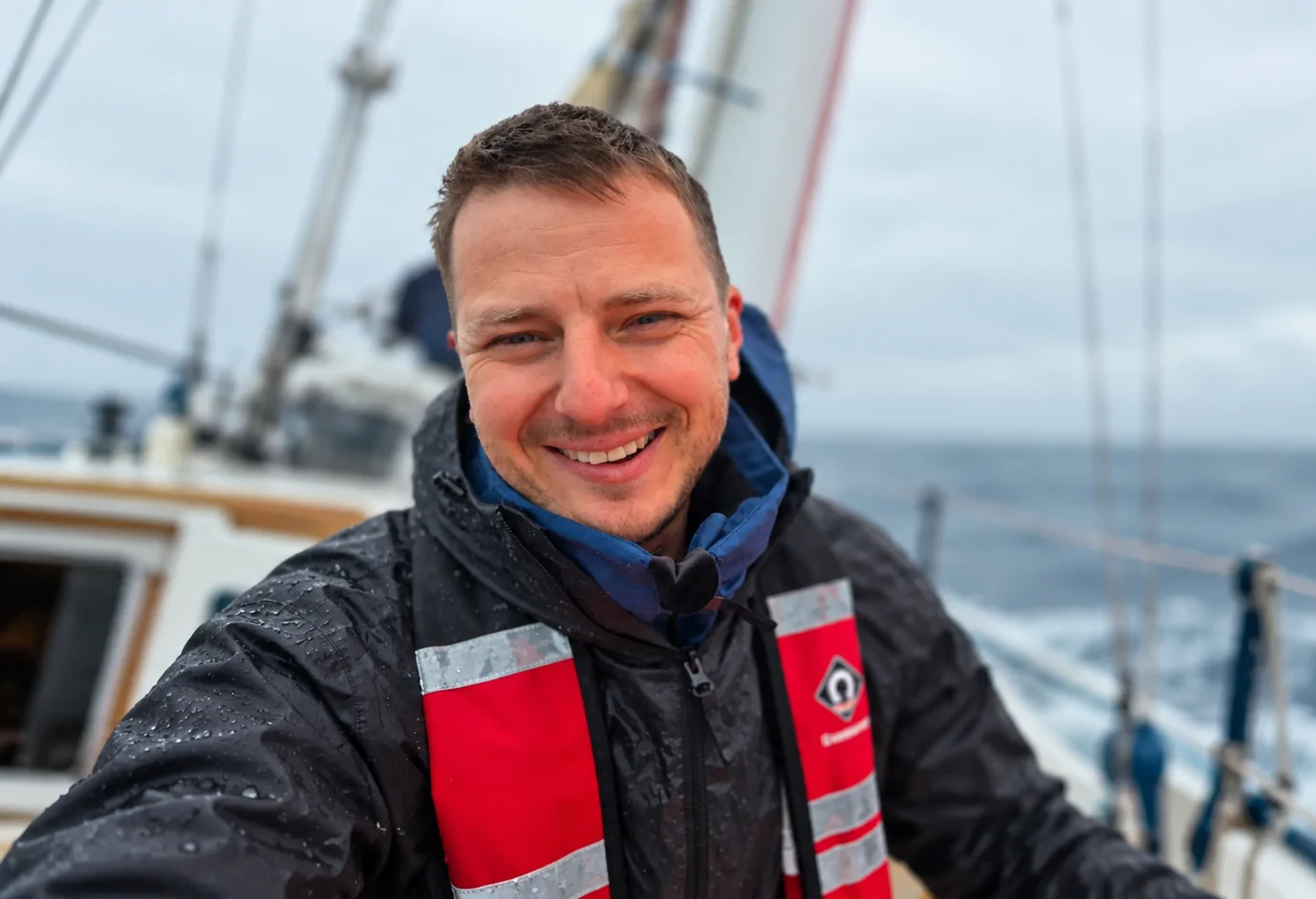
Founder and lead skipper Sergey Tarasov is a certified offshore skipper and ISSA yachting instructor with 9+ years of yachting and 100+ voyages behind him. Anyone who wants to learn the basics of handling the boat can; anyone who wants to read on deck instead can do that too.
No sailing or swimming experience is needed. Routes mostly stay close to shore and in sheltered water, and the rules on board cover the rest — safety, food, seasickness.
Participants are interviewed before booking, so the group shares similar expectations for the week. That matters more than it sounds when eight people share one boat.
If the licence patchwork is more trouble than it’s worth, look at the upcoming trips and pick a date. Send a request and Captain Sergey will help you choose the route — or the right boat to charter, if you’d rather sail on your own terms.
In France a sailboat is exempt from the license requirement regardless of motor power. Most other countries apply the same power and length thresholds to sailboats as to motorboats, and Italy requires a permit for sailboats specifically.
Yes. Jet-skis are treated as a separate category: in France they have required a license regardless of engine power since 2023, and similar rules apply in most other countries.
It varies by country and operator, and 18 is the most commonly stated minimum where an age is specified explicitly. Always check with the rental company, as some set a higher bar for faster boats.
You risk a fine and the boat can be impounded. In Russia, operating a vessel that requires a GIMS license without holding one carries a fine of 10,000–15,000 rubles under the Administrative Code.