What to Pack for a Sailing Holiday: A 7-Day List

The short answer to what to pack for a yacht: one soft bag, clothes for about three days, shoes with light non-slip soles and a small dry bag for your phone and documents.
A hard suitcase simply doesn’t work on a boat. There’s no wardrobe in the cabin, while an empty soft bag can be rolled up and stowed in a locker for the rest of the week.
Below is a basic yacht packing list for 7 days, three versions for different climates and an honest list of what not to bring. And the main thing: your captain will still send you the final list for your specific route and month.
A soft bag, around 7 kg of clothes and shoes that don’t leave marks on the deck. That covers almost any route.
Tip: weigh your packed bag at home. If it’s over 8–9 kg including the bag, you’re bringing too much.
Any universal list loses to your captain’s list. On our routes it arrives two weeks before departure, adjusted for the weather, the boat and the actual route.
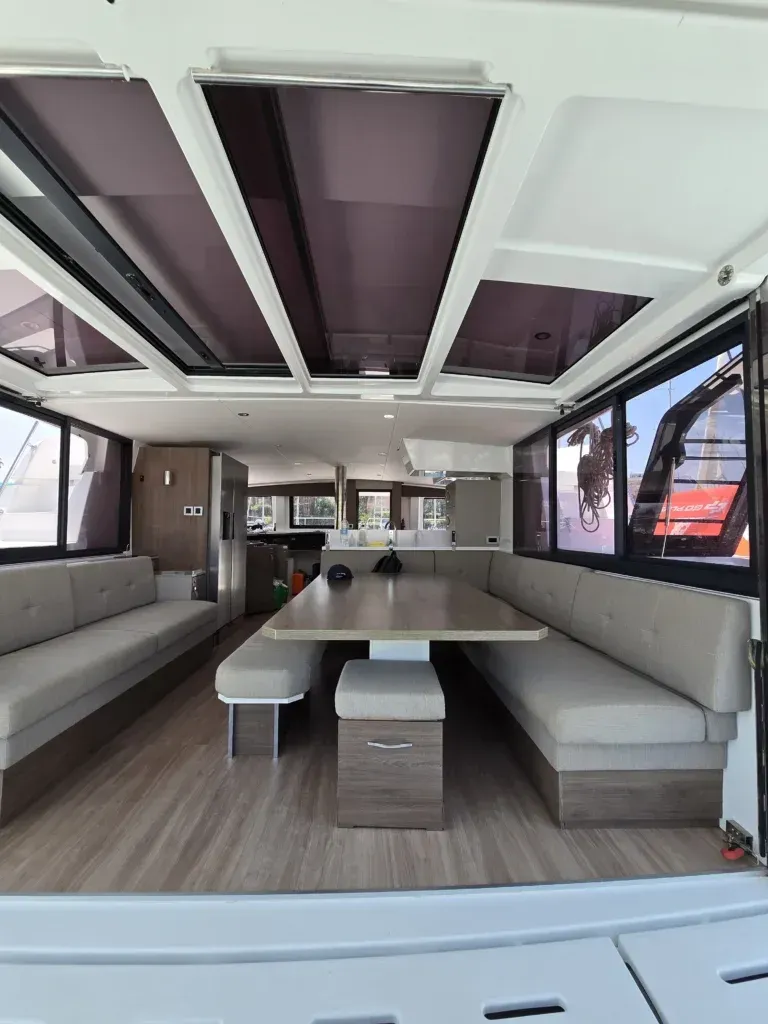
A hard suitcase can’t be folded, so all week it either stands in the middle of the cabin or lies on the bunk next to you. A soft bag goes into a locker on day one and you forget about it.
There are no wardrobes in the cabins. There are shallow shelves, nets and space under the bunk: a folded duffel fits there, a plastic shell on wheels doesn’t.
There’s a second reason too. Under sail the boat heels, and a hard case slides around the cabin, scratching the varnish on the furniture and the corners of the bulkheads. A soft bag just slumps and stays put.
If your route includes nights at anchor and trips ashore by dinghy, a roll-top bag with taped seams comes in handy: everything inside stays dry even in a short chop.
The basic kit is the same for any boat: clothes counted in quantities rather than categories, documents, a first-aid kit and chargers. Here it is.
Tip: check the socket type on board in advance and bring one adapter for all your cables, not three different ones.
The main rule for shoes is a light, non-marking sole with good grip on a wet surface. Everything else is up to you.
Dark rubber leaves black streaks on a white deck that someone then has to scrub off by hand, possibly you. Special deck shoes aren’t required: ordinary canvas sneakers with light soles work fine.
Many crews go barefoot inside the boat. Ask about it on the first day: it makes the question of what to wear on a yacht much simpler if it’s your first time.
Heels never work: they damage the deck and they’re dangerous in a swell. Flip-flops are for the pontoon and the dinghy, not for a restaurant ashore.
The amount of clothing stays the same, the type changes. In the Mediterranean the basic list plus a decent windbreaker is enough; in Norway you need thermal layers; in the tropics, light clothing that covers you from the sun.
On the water it’s almost always windier and cooler than on land, so a waterproof windbreaker belongs on the list in any season. The principle is the same everywhere: layers you can put on and take off on deck instead of one thick item.
| Mediterranean (Greece, Mallorca) | Norway, Lofoten, March | Tropics (Seychelles, Polynesia, Brazil) | |
|---|---|---|---|
| Outer layer | Light windbreaker | Waterproof jacket and trousers | Thin windbreaker for squalls |
| Base layer | T-shirts, shorts | Thermal underwear, fleece, warm socks | Light long sleeves and trousers |
| Shoes | Sneakers, flip-flops | Insulated waterproof boots | Sneakers, flip-flops, reef shoes |
| Protection | Sunscreen, cap, sunglasses | Hat, gloves, buff | Reef-safe sunscreen, repellent, rash guard for snorkelling |
| Most often forgotten | A warm top for the evening | A second pair of warm socks | A long-sleeve shirt for the sun |
If you’re heading north, take a look at our Arctic sailing expedition in Norway: your packing list depends a lot on the month.

Leave the hard suitcase, heels, hairdryer, full-size toiletries and half your clothes at home. These are the most common extra kilos.
Who this format won’t suit: people who change outfits twice a day, travel with a hard case, can’t do without a hairdryer and expect a wardrobe. A week on a boat means one soft bag, a shared cabin and a freshwater shower at the stern.
Yachting Retreat organises 7-day trips in small groups on a sailing catamaran or yacht with a licensed skipper, usually 6–8 people per boat. The founder and captain is Sergey Tarasov, a certified offshore skipper and ISSA instructor with 9+ years in yachting and 100+ voyages. Over 8 years: 25 countries and more than 200 participants.
The captain sends the packing list two weeks before departure, for the specific route, month and boat. Packing for Lofoten in August and for Greece in September looks very different.
You don’t need to bring food: on the first day part of the crew stocks up for the week at a big supermarket, and after that the group cooks on board. No experience is needed either: no technical gear is required, a windbreaker and layers are enough. You can learn the basics of handling the boat if you want to.
Keep seasickness tablets in your hand luggage: the skipper will show you how to adapt, and in 7 years everyone has managed. Practices on board (sharing circles, meditation, breathing, yoga) are optional; bring a thin mat if you want to join in, or use a towel.
Rules on board, swimming, meals and alcohol are covered on the rules and FAQ page. If the format is still unclear, start with what a yachting retreat is.

Check out the upcoming sailing trips and dates. Send us a request and we’ll send you a packing list for your route and answer any questions about getting ready.
Yes, it’s common practice to rinse T-shirts and swimsuits in seawater and dry them on the lifelines, where everything dries in a couple of hours. That’s why clothes for about three days are enough, not seven.
Plan for one soft bag of about 7–9 kg: that’s enough for a week on board. This usually fits into cabin luggage plus a small backpack, which saves time and money on checked baggage.
No, life jackets and standard safety equipment are on board. Only bring your own if you prefer the fit of your own life jacket or your own safety harness.
Keep your documents, medication and seasickness tablets, chargers and power bank, sunglasses and one set of clothes with a swimsuit in your hand luggage. That’s enough to set sail calmly on day one, even if your bag arrives later.