Norway and Fjords: Why the North Changes You Forever
There are landscapes that make you feel small in the best possible way. Norway and fjords do exactly that — they remind you that the world is vast, ancient, and indifferent to your calendar and your problems.
This is not a travel guide. This is an honest answer to the question: why do people who go to Norway come back different?
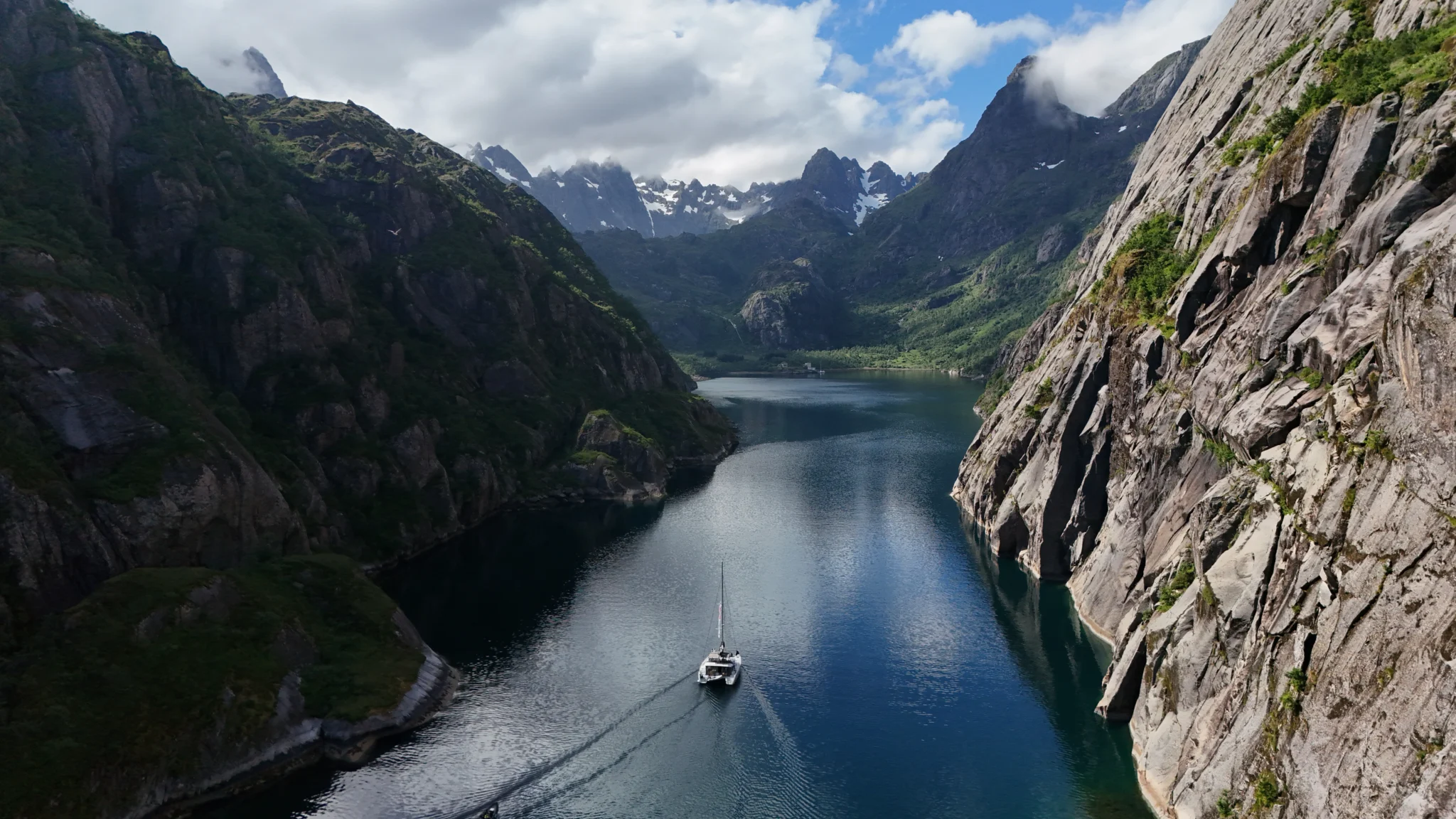
Most people know fjords from photographs. Long, narrow inlets of seawater cutting deep into the mountains. Sheer cliffs dropping hundreds of metres straight into the ocean. Waterfalls appearing out of nowhere. Snow on the peaks even in summer.
But photographs lie. They flatten everything. They remove the silence, the cold smell of the water, the sound of your own heartbeat when the engine goes off and the only thing you hear is wind against the sails.
Norway and fjords are not a backdrop. They are an experience that works on you from the inside.
The word “fjord” comes from Old Norse — it means “where one fares through.” The Vikings sailed these waters for centuries. The same cliffs they used as landmarks are the same cliffs you sail past today. That continuity alone is worth the journey.
Norway’s coastline, when straightened out, would stretch nearly 100,000 kilometres — longer than twice the circumference of the Earth. Most of that length is fjords, islands and inlets carved by glaciers over millions of years.
The most famous fjord regions:
Tromsø and the Arctic fjords — the northernmost sailing destination in Europe. This is where the northern lights dance in winter and the midnight sun shines in summer. Mountains here are covered in snow well into spring. The water is Arctic cold, the light is unlike anything you’ve seen, and the silence is total.
The Lofoten Islands — dramatic peaks rising directly from the sea. Fishing villages painted red and yellow against the snow. Some of the best Arctic fishing in the world. A photographer’s dream and a sailor’s paradise.
The Western Fjords (Sognefjord, Geirangerfjord) — the postcard version of Norway. Cascading waterfalls, steep green cliffs, tiny villages only reachable by boat. UNESCO World Heritage sites that somehow still feel undiscovered when you arrive by sail.

You can see Norway and fjords by car, by cruise ship, by helicopter. But none of these compare to sailing through them on a small vessel.
From a cruise ship, you are one of two thousand passengers. The fjord is a background for your selfie. You dock, walk around for two hours, reboard. The experience is managed, curated, safe.
From a sailboat with eight people, the fjord is yours. You anchor in a bay that doesn’t appear on tourist maps. You swim in water that is cold enough to make you gasp and then laugh. You fish for cod from the stern and eat it an hour later. You sit on the bow at midnight when the sun is still above the horizon and feel something shift inside you.
That shift is what people come back for.
March is arguably the most extraordinary time to sail Norway and fjords. Here is why:
The northern lights — aurora borealis — are most active around the spring equinox. The science involves solar particles interacting with Earth’s magnetic field. The experience involves standing on the deck of a catamaran at midnight, watching green and purple light move across the entire sky, and trying to understand why it makes you want to cry.
It is not just a light in the sky. It is the moment when you realise how small your daily worries are and how large the world actually is.
In March in Tromsø:
The contrast of warm sauna steam against the cold Arctic air, followed by a plunge into the fjord, is something your nervous system will remember for years.
There is a reason the Vikings came from here. Norway and fjords do something to a person. The landscape is too powerful for small thinking. The scale of the mountains, the depth of the water, the width of the sky — all of it pushes you toward something larger than your usual self.
People who sail the Norwegian fjords often describe the same experience: a feeling of deep groundedness. As if the mountains transferred something to them — solidity, patience, perspective.
Modern life is fast, fragmented, loud. Norway and fjords are the opposite. Slow, whole, silent. The contrast does its work quietly and thoroughly.

Fishing in the Norwegian fjords is not a leisure activity. It is a ritual that connects you to thousands of years of northern tradition.
You fish in places where tourist boats never go. Wild cod pulled directly from the Arctic water, cooked on board the same evening. The taste is different from anything you find in a restaurant — cleaner, firmer, more honest.
There is something about catching your own food in one of the most remote, beautiful places on Earth that reorders your priorities. You stop thinking about your inbox. You start thinking about the next wave.
Best time to visit:
Getting there:
Tromsø Airport (TOS) has direct connections from most major European cities. Oslo, Copenhagen, Amsterdam and London all have direct flights.
What to expect on board:
A heated catamaran with private cabins, full galley, and a licensed skipper who has sailed these waters for years. Professional arctic suits provided for every participant in winter — you will be warm and comfortable regardless of the weather.
Sailing experience needed: None. The skipper handles navigation and safety. You are there to experience, to breathe, to be present.
Group size: Maximum 8 people. This is not a cruise. It is an expedition with a small team.
Not souvenirs. Not photographs (though there will be thousands). Something harder to explain.
A sense of scale. The understanding that you are one small creature on a very large planet, and that this is not frightening — it is freeing.
A reset of priorities. After a week of silence, stars, cold water and real food, the things that felt urgent before departure reveal themselves as optional.
Friendships. There is something about sharing a small vessel in a large landscape that accelerates human connection. People who were strangers on day one are genuinely close by day seven.
And for many — a decision. To travel more. To work less. To choose the experiences that leave a mark over the ones that simply pass the time.
Norway has approximately 1,190 fjords. The deepest — Sognefjord — reaches 1,308 metres below sea level. The longest is 204 kilometres from the open sea to its innermost point. The cliffs lining Geirangerfjord rise 1,400 metres above the water.
These numbers mean nothing until you are sailing between those cliffs in a boat that suddenly feels very small. Then they mean everything.
If something in this article resonated — trust that feeling.
Our next sailing expedition to Norway departs March 2027 from Tromsø. Seven days in the heart of the northern lights season, on a heated catamaran with a licensed skipper, Arctic suits for every participant, and a small group of people who chose the extraordinary over the ordinary.
👉 See our upcoming Norway fjords expedition at yachtingretreat.com
The fjords are waiting. They have been waiting for millions of years. They can wait a little longer — but you probably shouldn’t.

Welcome to
 25.07-01.08.2026
01.08-08.08.2026
25.07-01.08.2026
01.08-08.08.2026  7 days