Arctic Sailing: What Happens When You Go North of Everything
Most people draw a line in their minds. Below it — travel. Above it — survival. Arctic sailing lives above that line. And the people who cross it rarely want to come back.
This is not about extreme sport. It is not about endurance or suffering. It is about what happens to a person when the world becomes very simple: water, wind, ice, light, and eight people who chose to be there.
Arctic sailing is exactly what it sounds like — sailing in Arctic or sub-Arctic waters, where the rules of ordinary travel no longer apply.
The sun doesn’t set in summer. The northern lights don’t stop in winter. The fish are enormous. The silence is total. The mountains look like something from a film that hasn’t been made yet.
For our purposes, Arctic sailing means the waters around northern Norway — specifically the region around Tromsø, above the 69th parallel. This is the most accessible Arctic sailing destination in the world, with direct flights from most European cities and conditions that are extraordinary without being genuinely dangerous.
This is Arctic sailing for humans who have lives, jobs and return tickets — not for professional explorers with sponsors.
There is a scientific explanation and a real one.
The scientific explanation: the combination of cold water, clean air, physical activity, disrupted sleep cycles from constant light or darkness, and removal from digital stimulation produces measurable changes in cortisol levels, heart rate variability and cognitive function. Studies on wilderness immersion consistently show improvements in creativity, emotional regulation and sense of meaning after as little as three days in remote natural environments.
The real explanation: the Arctic is too large and too indifferent for small thinking. Your problems don’t fit in the landscape. They dissolve somewhere between the moment you see your first midnight sun and the moment you pull a cod out of Arctic water with your own hands and eat it an hour later.
People who do Arctic sailing describe the same thing in different words. A reset. A recalibration. A return to something essential that city life had slowly covered over.

Tromsø sits at 69°40′ North — deeper inside the Arctic Circle than most people will ever travel. It is a city of 75,000 people with a university, good restaurants and direct flights from Oslo, London, Amsterdam and Copenhagen.
It is also surrounded by some of the most dramatic sailing waters on the planet.
The fjords around Tromsø are different from the western Norwegian fjords that appear on postcards. These are Arctic fjords — darker, wilder, more severe. The mountains are snowcapped well into May. The water temperature in March hovers around 4°C. The light in winter is a permanent blue dusk that lasts four hours, during which the sky does things that no photographer has ever fully captured.
This is where we sail.
Let’s be direct about something. The northern lights are the reason most people consider Arctic sailing for the first time. And the northern lights are genuinely as extraordinary as you have heard.
But the photographs still lie.
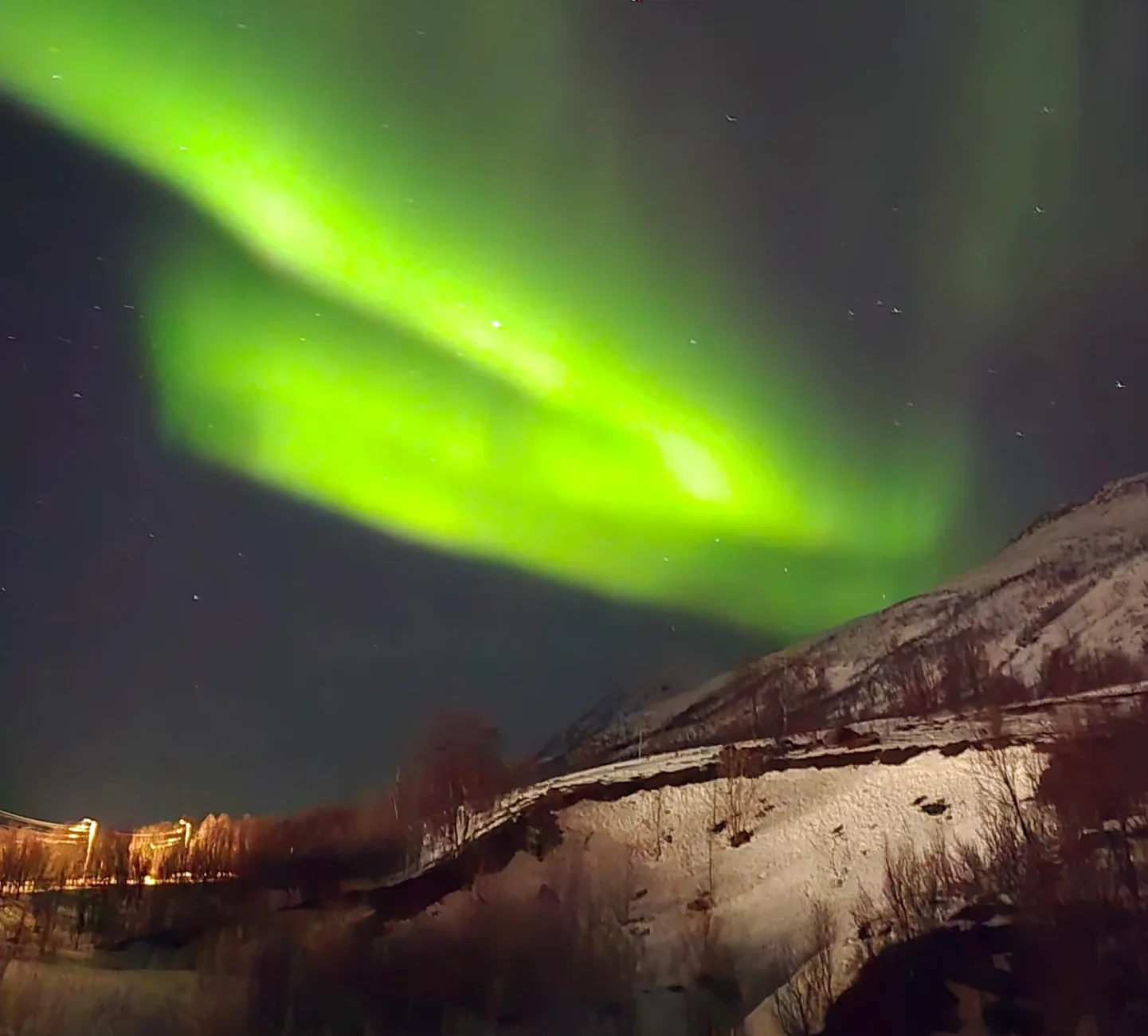
The aurora borealis in photographs is a static smear of colour across a dark sky. In reality, it moves. It pulses. It shifts from green to purple to white in seconds. On a calm night, anchored in a fjord, with the reflection of the lights in the black water below you and the sound of nothing around you — it is one of the most disorienting experiences available to a human being in the modern world.
Disorienting in a good way. The kind of disorientation that makes you question what you have been doing with your time.
When to see the northern lights:
The aurora season runs from late September to late March. The peak — statistically the highest probability of intense aurora activity — falls around the spring and autumn equinoxes. March is the sweet spot: peak aurora season, improving daylight hours, and the beginning of the Arctic spring.
On a clear night in March near Tromsø, the probability of seeing the northern lights is approximately 80–90%.

Long before people went north for the aurora, they went north for the fish.
Arctic waters are among the most productive fisheries on the planet. The combination of cold, oxygenated water, deep fjords and ocean currents creates conditions where fish grow large, plentiful and extraordinarily good to eat.
Arctic cod, caught from the stern of a catamaran in a fjord where no tourist boat goes, cooked on board the same evening with whatever else the galley has — this is a meal that ruins restaurant fish forever.
There is also something primal about fishing in the Arctic. You are doing something that people have done in these same waters for ten thousand years. The technology has changed slightly. The essential act — finding food in the ocean and bringing it back — has not.
Most participants on our Arctic sailing expeditions have never held a fishing rod seriously before. By day three they are competitive about it.
The Scandinavians figured something out that the rest of the world is slowly rediscovering: the combination of extreme heat and extreme cold does remarkable things to the human body and mind.
On our Arctic sailing expedition, we build sauna sessions into the programme. Steam heat with panoramic views of snow-covered fjords. Then — for those who want it — a plunge into the Arctic Ocean.
The water temperature is around 4°C. The experience lasts approximately fifteen seconds. The effect lasts the rest of the day.
The physiological response is dramatic: adrenaline, endorphins, a sudden and complete reset of the nervous system. The psychological effect is harder to describe but consistently reported: a sense of being absolutely, completely present. Whatever you were thinking about before you hit the water is gone. There is only now, and now is very cold, and you are laughing.
This is the Arctic version of mindfulness. It is faster than meditation and more convincing.
Немає кімнат для відображення.Morning:
The sun rises late in March — around 7am. But the light starts earlier, a deep blue that turns the snow on the mountains electric. Breathing practices on deck. Breakfast prepared in the galley. Coffee. The quiet conversation of eight people who slept well because the air is clean and the silence is complete.
Day:
Sailing through the fjords. The catamaran moves under power when the wind is absent, under sail when it arrives. The skipper navigates. Participants help if they want to — most do by day two. Arctic fishing from the stern. Stops at anchorages that don’t appear in guidebooks. Hot lunch on board.
Afternoon:
The light in March does something extraordinary around 3pm. It turns golden and stays golden for two hours. Everything — the snow, the water, the rocks — looks like it has been lit from within. This is when people take the photographs that they can never quite explain to people who weren’t there.
Evening:
Sauna, if the conditions allow. Dinner from the day’s catch plus whatever the galley has prepared. The Sharing Circle — an evening practice where the group gathers and speaks honestly about what the day brought up. Not therapy. Just humans being real with each other in a context that makes that easier than usual.
Night:
The aurora, if it comes. And in March near Tromsø, it usually does.
A common concern about Arctic sailing: won’t I be cold?
The answer is: not on our expeditions.
We sail on a heated catamaran — a vessel designed for comfort in cold conditions. Below deck, the saloon is warm and well-lit. Private cabins with proper bedding. A full galley. Hot drinks always available.
On deck, every participant receives a professional arctic suit — the same equipment used by offshore sailors and rescue workers in northern waters. Waterproof, windproof, thermally insulated. You can stand on the bow in -10°C and be comfortable.
The North is harsh. For you, it will be warm.

People who have sailed warm-water destinations — Greece, the Caribbean, the Canaries — often ask what makes Arctic sailing different.
The answer is the same thing that makes northern light different from tropical light. Everything is more concentrated. More intense. The contrasts are greater — between the cold and the sauna warmth, between the silence and the wind, between the darkness and the aurora.
Warm-water sailing is beautiful. Arctic sailing is transformative. The landscape demands more from you, and in exchange it gives more back.
Not for extreme athletes. Not for people who like discomfort for its own sake.
Arctic sailing is for people who want a genuine experience — one that requires something from them and gives something real in return.
It is for the person who has been to enough beach resorts and found them beautiful but somehow forgettable.
It is for the person who knows there is something more available in the world but hasn’t found the right vehicle for it yet.
It is for the person who has read about the northern lights since childhood and thinks, at some point, that perhaps it is time to actually go.
No sailing experience required. Maximum 8 participants. Licensed skipper on board at all times.
The numbers are interesting but the experience is better:
1,190 — the number of fjords in Norway
4°C — approximate water temperature in the Arctic Ocean near Tromsø in March
80–90% — probability of northern lights on a clear night in peak season
69°40’N — the latitude of Tromsø, deep inside the Arctic Circle
8 — maximum group size on our expeditions
0 — the number of participants who have said they regretted going
There is a concept in Norwegian culture called friluftsliv — roughly translated as “open air life.” It is the idea that spending time in nature is not a leisure activity but a fundamental human need. That the outdoors is not something you visit on weekends but something you require the way you require sleep and food.
The Arctic makes this obvious in a way that milder landscapes cannot. When the environment is this powerful, the idea that you could get the same effect from a gym membership or a spa day becomes impossible to maintain.
People who do Arctic sailing tend to reorganise their lives afterward. Not dramatically — they don’t quit their jobs and move to Norway (usually). But they start protecting their time differently. They spend more of it outside. They become less tolerant of things that are just filling time.
The Arctic has a clarifying effect. Everything that matters becomes obvious. Everything that doesn’t becomes unimportant.
If something in these words has landed — take it seriously.
Our next Arctic sailing expedition departs March 2027 from Tromsø, Norway. Seven days in the northern lights season. Heated catamaran, licensed skipper, professional arctic suits for every participant, arctic fishing, sauna and plunge, Sharing Circles under the aurora.
Maximum 8 participants.
👉 See our upcoming Arctic sailing expedition at yachtingretreat.com
The North has been there for millions of years. It will be there next year too. But the group fills up, and the people who go in March 2027 will carry something with them that no one else will have.
Go north. Something is waiting for you up there.