Sailing for Beginners: Your First Day on a Yacht, Explained

If you’re joining a trip with a skipper, sailing for beginners requires no licence, no certificate and no experience at all. The skipper runs the boat and carries the legal responsibility. Your job is to listen, help a little, and stay out of the way of the winches.
The licence question only becomes real if you want to rent a yacht without a skipper. That’s a different situation with real paperwork behind it.
Below is what actually happens on your first day on board — arrival, shopping, briefing, first passage — along with the handful of words you’ll hear in the first hour and the safety rules that matter more than anything else.
No, not if there’s a skipper on board. On a skippered charter the captain manages navigation, weather and docking and takes all responsibility, so guests need no licences or certificates of any kind.
Bareboat charter is the opposite case. Renting a yacht without a skipper legally requires a sailing licence (bareboat or inshore level) plus a VHF/DSC radio operator licence — an SRC. A basic VHF familiarisation course on its own is not enough.
| Trip with a skipper | Bareboat charter | |
|---|---|---|
| Sailing licence | Not required from guests | Required (bareboat/inshore) |
| Radio licence | Not required | VHF/DSC SRC required |
| Who is responsible | The skipper | You |
| Suits a first-timer | Yes | No |
Almost every first-time sailor should start skippered. If you’re curious about the other route, read what bareboat rental actually involves before you plan around it.
Your first day is mostly logistics, a briefing and a short first passage — not hours of hard sailing. Here’s the usual order.
For the first day or two, stay on deck while the boat is moving and keep the horizon in sight. Going below while underway is the fastest way to feel ill; do your cabin unpacking once the boat is moored or anchored.
Tip: offer help during docking even if you don’t know what you’re doing. Handing a fender over the rail or holding a line is a job anyone can do on day one, and it’s how you learn the boat.

You need about ten words, not a textbook. The skipper will explain the rest as it happens.
Directions on a boat are fixed to the boat, not to you. The bow is the front, the stern is the back, starboard is the right side and port the left — and none of that changes depending on which way you happen to be facing.
There’s a second layer that beginners rarely hear about: in sailing, left and right matter less than the wind. The windward side is the one the wind hits; the leeward side is sheltered from it. Most instructions on deck make sense once you know which is which.
Tack matters beyond vocabulary. Under Rule 12 of the international collision regulations, when two sailing boats on different tacks are in sight of each other and there’s a risk of collision, the boat on port tack gives way to the boat on starboard tack. Other right-of-way rules still apply separately — it isn’t a blanket law of the sea, which is how most casual explanations get it wrong.

Yacht safety comes down to three things: life jackets, where you put your hands, and not leaving the cockpit without permission. Falling overboard is the most critical danger on a yacht, and nearly every rule exists to prevent it.
Footwear counts too: non-slip, non-marking soles, closed toes, a secure fit. Flip-flops are not deck shoes. Our full rules on board and FAQ covers the daily living side, and there’s a separate 7-day packing list if you’re still deciding what goes in the bag.

The skipper is. The route can be discussed by the whole crew before departure, but once the boat is at sea, decisions belong to the skipper alone.
If conditions deteriorate, the crew’s job is to listen and act on commands quickly. If the weather turns bad on the day a trip starts, the skipper can change the route or reduce the number of people on board — and that’s not negotiable by vote.
This isn’t authority for its own sake. Individual decisions taken at sea without the skipper’s approval are what turn a rough afternoon into an accident. If you need full control from day one, or you’d rather not follow someone else’s instructions, a skippered trip is the wrong format for you — look at training toward your own licence instead.
Yachting Retreat runs 7-day small-group sailing trips on catamarans and yachts with a licensed skipper, built so that people with zero sailing experience can join safely. Groups are typically 6 to 8 people per boat, so a beginner gets actual attention rather than being one of twenty on a crowded deck.
Day one follows the pattern above: bags into the cabins, part of the crew shops for the week’s food at a big supermarket, the skipper runs the briefing, then a short first passage. After that the group cooks and eats on board and ashore.
You can learn to handle the boat if you want to — steering, trimming, reading the wind — or simply be part of the crew without ever touching the helm. Founder and lead skipper Sergey Tarasov is a certified offshore skipper and ISSA yachting instructor with 9+ years of yachting and 100+ voyages, and he teaches sailing from scratch. If learning is the main point for you, the captain’s school is the more direct route.
Everyone is interviewed before booking, so the group shares roughly the same values about how a week at sea should feel.
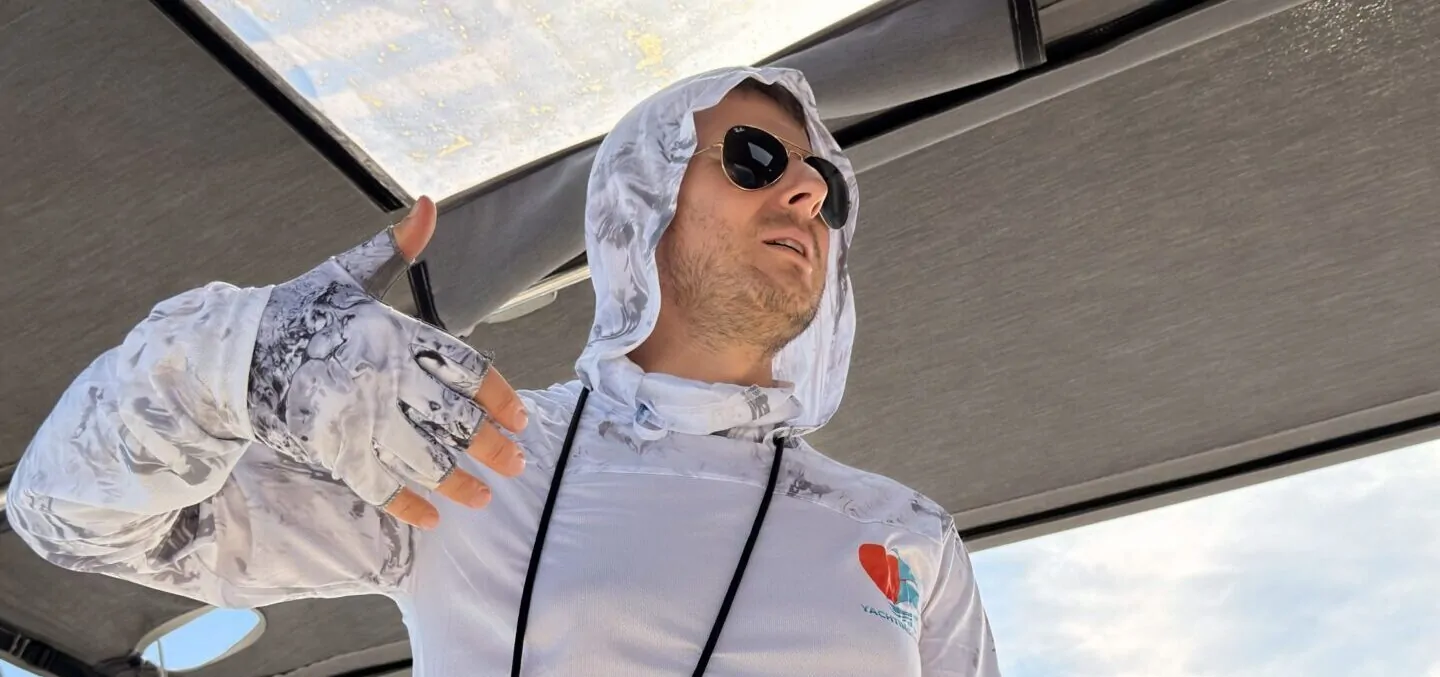
If your first time sailing is still an idea rather than a date, look through the upcoming trips and see which season and sea suit you. Send a request and the skipper will tell you honestly whether that route works for a complete beginner.
Most people adapt within the first day or two, and standard motion-sickness pills work well. Staying on deck with the horizon in view helps more than anything else; in seven years of Yachting Retreat trips every participant has coped.
No. Non-swimmers join regularly — the route mostly stays close to shore and in sheltered water, life jackets are on board for everyone, and the skipper’s safety rules apply to the whole crew.
Deck shoes with non-slip, non-marking soles and closed toes, plus light layers and something windproof. It is usually cooler on the water than ashore, so bring more clothing than the forecast suggests even in summer.
Yes, on a skippered trip beginners regularly take the helm once the skipper judges conditions suitable. Steering also helps with mild seasickness, because it forces you to focus on the horizon and the compass.